Showing posts with label green. Show all posts
Jun 25, 2009

World's Largest Recycled Artwork

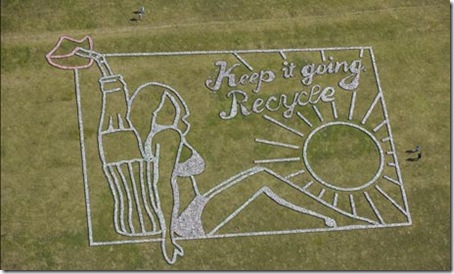
Take a look at the picture. This is a sculpture made of thousands of used aluminum cans collected from around the UK. In fact, it is the world's largest recycled artwork, which was unveiled at Seven Sisters, East Sussex to mark Recycle Week 22-28 June 2009. Recycle Week is a new drive to encourage consumers to recycle their cans and bottles.

world's largest recycled artwork

The giant sculpture, called Precious Metal, took a team of artists a week to complete and can only be fully viewed from the air. It is inspired by a classic 1949 summer poster from the Coca-Cola, which shows a swimsuit-clad lady relaxing in the sun. The odd sculpture was led by the award-winning Cornish sculptor Robert Bradford.

via: http://www.guardian.co.uk/environment/2009/jun/22/precious-metal-recycle-week

read more “World's Largest Recycled Artwork”
Jun 21, 2009

'Lilypad' City by Vincent Callebaut

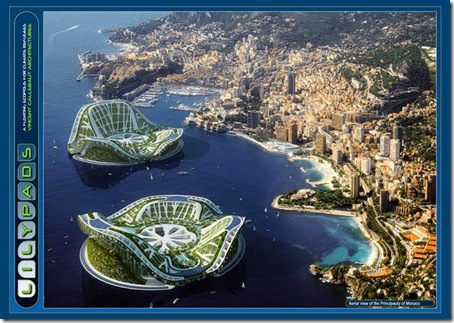
In future, change in climate and increase in ocean level will create havoc in many parts of the world. To deal with water rising and worldwide ecological crisis, architect Vincent Callebaut has designed a floating Ecopolis called "Lilypad".  Lilypad is a true amphibian half aquatic and half terrestrial city, able to accommodate 50,000 inhabitants. Take a look at these pictures of the original concept.

lilypad_photo

Inspired of the highly ribbed leave of the great lilypad of Amazonia Victoria Regia, Lilypad is a prototype of auto-sufficient amphibious city with double objective not only to widen sustainability in offshore the territories of the most developed countries but above all to grant the housing of future climatic refugees.

lilypad_photo2

Lilypad is a true amphibian half aquatic and half terrestrial city, able to accommodate 50,000 inhabitants and inviting the biodiversity to develop its fauna and flora around a central lagoon of soft water collecting and purifying the rain waters. This artificial lagoon is entirely immersed ballasting thus the city. It enables to live in the heart of the subaquatic depths. The multifunctional programming is based on three marinas and three mountains dedicated respectively to the work, the shops and the entertainments. The whole set is covered by a stratum of planted housing in suspended gardens and crossed by a network of streets and alleyways with organic outline.

lilypad_photo3

In this way, the goal of Lilypad is to create a harmonious coexistence of the couple Human / Nature and to explore new modes of living the sea by building with fluidity collective spaces in proximity, overwhelming spaces of social inclusion suitable to the meeting of all the inhabitants – denizen or foreign-born, recent or old, young or aged people.

lilypad_photo4

lilypad_photo5

via: Vincent Callebaut http://www.vincent.callebaut.org/page1-img-lilypad.html

read more “'Lilypad' City by Vincent Callebaut”
May 17, 2008

The Solar-powered Bra


Love eco-friendly and green gadgets? I am sure that you will like this "Solar-powered Bra"! This special bra comes with a detachable solar panel which can produce enough energy to power an iPod or mobile phone. It is also equipped with plastic pouches that can be filled with water.

The high quality organic cotton, used in production of this bra makes it eco-freindly. The Daily Telegraph reports that, this Solar-powered bra is still in concept stage and needs further improvements before releasing in stores.


read more “The Solar-powered Bra”
May 10, 2008

Sahara desert formed slowly


A new research is based on deposits from a unique desert lake in remote northern Chad suggests that Sahara, the biggests desert in the World, gradually transformed into desert from a green savannah. This study contradicts past research that suggested the region dried up within a few hundred years.

Lake Yoa, sustained by prehistoric groundwater, has survived for millennia despite constant drought and searing heat. The body of water contains an unbroken climate record going back at least 6,000 years, said study lead author Stefan Kröpelin of the Institute of Prehistoric Archaeology at the University of Cologne in Germany. Ancient pollen, insects, algae, and other fossil clues preserved in the lake's sediments point to a gradual transformation to a desert environment.

The pollen samples revealed that the decrease in tropical trees accelerated after 4,800 years ago, while desert plants took root between 3,900 and 3,100 years ago. The study supports previous archaeological findings that human populations in the Sahara moved south over several millennia, following the monsoon rains.

read more “Sahara desert formed slowly”
Mar 30, 2008

HDPE products and Recycling


Have you heard about HDPE? High Density Poly Ethylene (HDPE) is a form of recyclable plastic, that is commonly used in manufacturing of consumer products. It was invented by Paul Hogan and Robert Banks of Phillips Petroleum in 1951. Chemically, is a polymer molecule where all the atoms are linked together in a long chain. HDPE is created by a catalytic process, and is normally prepared from ethylene. HDPE's melting point of 130 degrees Celsius and it is resistant to alcohols, acids and bases. HDPE is strong but lightweight and absorbs very little moisture. That's why it is used in manufacturing of different products.

HDPE has been approved of as a product for food packaging by various institutions, including the FDA, NSF and USDA. Nowadays HDPE is used in a wide range of applications and products. From detergent bottles to milk jugs, and from the laboratory to household chemicals, HDPE products are used every where.

The good thing is that HDPE Material can be recycled. Recyclable waste of HDPE is called as Scrap HDPE. They comes in all forms, shapes and colors. Before starting the process of recycling, the recyclable HDPE materials are sorted and cleaned. It helps in adding value to the quality of recycled products. Then contamination free flakes of Scrap HDPE is used to manufacture new products such as bags, bottles, containers, clothing, carpet, drums, plastic lumber, etc.

HDPE is an important and remarkable substance. Recycling of this kind of plastic products will help us to keep this world clean. So, don't throw away your plastic wastes. Just collect and put them in special bin, from which the wastes will be picked by a public or private hauling company.

read more “HDPE products and Recycling”
Feb 25, 2008

Virgin Atlantic's Biofuel Demonstration Flight


Virgin Atlantic set an aviation milestone on Sunday, by flying the first commercial aircraft powered by biofuel. The Boeing 747 of Virgin Atlantic made the 90-minute journey from London to Amsterdam with one of its four main fuel tanks filled with a blend of coconut and babassu oil.

Biofuels, which are mostly derived from crops such as grain, sugar and vegetable oils, are seen by proponents as a good way to cut carbon emissions while also reducing dependence on fossil fuels. This flight of Virgin Atlantic proves that Biofuels is feasible in aeroplanes and can produce less carbon dioxide than normal jet fuels. link


read more “Virgin Atlantic's Biofuel Demonstration Flight”
Feb 8, 2008

Biofuels increases Global Warming!


According to a new study, growing crops to make biofuels may accelerate global warming, not slow down its effects. How? When farmers clear native ecosystems such as forests or grasslands to grow crops, this gives off substantial amounts of carbon dioxide, the primary greenhouse gas that fuels climate change.

Biofuels such as ethanol from corn and biodiesel from palm oil typically start out with a "carbon debt." Before these biofuels could reduce individual carbon dioxide emissions, they would first have to pay off this debt, which would take decades or centuries.

"I was surprised that with so many of the crops, it takes so long before you break even [on carbon emissions]," said study co-author David Tilman of the University of Minnesota in St. Paul. The university and the nonprofit group the Nature Conservancy conducted the study. Link

read more “Biofuels increases Global Warming!”
Nov 25, 2007

Zero Carbon House


A Zero Carbon House! This house is a low energy demonstration project to show how renewable energy can create a unique living experience on a remote island in a severe climate. A holistic approach has been taken to eliminating household carbon emissions that would normally result from heating and powering the home, running the family car and growing and transporting food.

The house is based on a standard design from a timber frame company. Timber is a low embodied energy, renewable material that will be sourced from Scotland to minimise transportation costs and impacts.


The house will be constructed to very high levels of energy efficiency. Heating will be provided by an air-to-water heat pump serving an underfloor heating system and providing domestic hot water via a heat store. Link


read more “Zero Carbon House”
Nov 24, 2007

How to Save the Environment?


A cleaner and safer environment, the right of every creature on earth! Well, how to save the Environment? We can save it by taking some wise actions in our day to day life. To know more about the various ways, read the 100 ways to Save the Environment. Some of those ways are:
  • Clean or replace air filters on your air conditioning unit at least once a month.
  • Turn off unneeded lights even when leaving a room for a short time.
  • Wash clothes with warm or cold water instead of hot.
  • Learn about alternatives to household cleaning items that do not use hazardous chemicals.
  • Use traps instead of rat and mouse poisons and insect killers.
  • Use recycled wood chips as mulch to keep weeds down, retain moisture and prevent erosion.
  • Use mailer sheets for interoffice mail instead of an envelope.Use mailer sheets for interoffice mail instead of an envelope.
  • Encourage your school and/or company to print documents with soy-based inks, which are less toxic.
  • Avoid slow-burning, smoldering fires. They produce the largest amount of pollution.
  • Purchase radial tires and keep them properly inflated for your vehicle.
  • Wash and dry only full loads of laundry and dishes.
  • Replace old toilets with new ones that use a lot less water.
  • Check your car for oil or other leaks, and recycle motor oil.
  • Never dump anything down a storm drain.
  • Buy items in bulk from loose bins when possible to reduce the packaging wasted.
  • Maintain and repair durable products instead of buying new ones.
  • Use reusable containers to store food instead of aluminum foil and cling wrap.
  • Buy used furniture - there is a surplus of it, and it is much cheaper than new furniture.

read more “How to Save the Environment?”
Oct 7, 2007

Greener Paints, Cosmetics and Holograms


A plant-like micro-organism mostly found in oceans could help in manufacturing of cheaper and 'greener' paints, cosmetics and even holograms. The tiny single-celled 'diatom', which first evolved hundreds of millions of years ago, has a hard silica shell which is iridescent. The shell displays vivid colours that change depending on the angle at which it is observed. This effect is caused by a complex network of tiny holes in the shell which interfere with light waves.

UK scientists have now found an extremely effective way of growing diatoms in controlled laboratory conditions, with potential for scale-up to industrial level. This would enable diatom shells to be mass-produced, harvested and mixed into paints, cosmetics and clothing to create stunning colour-changing effects, or embedded into polymers to produce difficult-to-forge holograms. Link


read more “Greener Paints, Cosmetics and Holograms”

World's Greenest Skyscraper


The Bank of America Tower at One Bryant Park in New York City is a $1 billion skyscraper project currently undergoing construction, on the west side of Sixth Avenue, between 42nd and 43rd Street, opposite Bryant Park in Midtown Manhattan. It has been designed by Cook+Fox Architects to be one of the most highly efficient and ecologically friendly buildings in the world. Construction is expected to be complete in 2009.

In Bank of America's report on the construction of the building, it cited that the design of the building will make it environmentally friendly, using technologies such as floor-to-ceiling insulating glass to contain heat and maximize natural light, and an automatic daylight dimming system. The tower also features a greywater system, which captures rainwater and reuses it. Bank of America also states that the building will be made largely of recycled and recyclable materials.

Another interesting innovation is that not only is air entering the building purified to an impressive degree, but the air exhausted is also cleaner, thus effectively making the tower a giant air filter for Midtown Manhattan. via Wikipedia

Watch the Reuters Video on The Bank of America Tower:


read more “World's Greenest Skyscraper”
Oct 4, 2007

Bicycle Lawnmowers


Take a look at these Bicycle Lawnmowers! They are ecofriendly, as they are fossil-fuel free. These Bicylce Lawnmowers uses the power of legs to cut the grasses. It could be a good tool for excercise cum lawnmowing. An innovative, gree idea, that may save the world! via TreeHugger


read more “Bicycle Lawnmowers”
Sep 21, 2007

Floating Solar Island


The United Arab Emirates has just contracted with a Swiss firm, CSEM, to purchase a floating solar island. The island, which will basically float on a ring-shaped raft, was conceptualized a while ago by CSEM, but until now they haven't found any buyers. The prototype being comissioned by the UAE will first be tested in a nearby desert before the concept is moved onto the ocean. This 100 meter wide structure will cost $5 Million and could generate roughly 1 megawatt.

The plant will produce energy by concentrating solar power onto pipes containing water. The water will boil, and be used to spin turbines. Once shipped off-shore, the islands could be used to convert seawater to hydrogen, allowing them to be autonomous and untethered to the shore. The hydrogen could be picked up by barges, instead of having to transport the electricity to shore via a physical connection. Link

This pilot project is being designed mostly to test the feasibility of the solar islands; CSEM says that the islands so far look like they will be cost-effective as long as they are deployed in areas with more than 350 days of sunlight that are near the equator. That's a lot of sunlight, but the area of the coast of the UAE fits the bill. Of course, it's also necessary for the structures to be able to survive a serious storm either by motoring to shore to avoid it, or being resilient enough to live through it.


read more “Floating Solar Island”
Aug 6, 2007

Solar Powered Tractor

Solar Powered Tractor
John Howe, a retired engineer and inventor, wanted to do something with his old tractor. He converted it to a solar powered tractor, without altering the original machinery. It is a great contribution towards conservation of fossil fuel.

read more “Solar Powered Tractor”
Jun 19, 2007

Pope Goes Solar!


Pope Benedict XVI is very very concerned about conserving resources. So, he orders to go for solar for electricity. That's a very good news. Atleast some people will be inspired by this. In many building of Vatican, solar panels will be installed. First in line is the Pope Paul VI auditorium, which seats 6,300 people.

The integrated PV cells will provide enough electrical power to provide illumination and temperature control for the auditorium. When not in use, excess power will be fed into the Vatican's grid.


Source: Discovery
read more “Pope Goes Solar!”
Related Posts Plugin for WordPress, Blogger...